Your cart is currently empty!
Power of Attorney (POA): Everything You Need to Know
One of the most important tools for making sure our parents financial and medical needs are handled smoothly is a Power of Attorney, or POA. This legal document allows someone your parent trusts to make decisions and act on their behalf if they become incapacitated. Below is everything you need to know about Power of Attorney (POA).
Key Takeaways:
- Having a POA means you can step in to access medical records and make health and financial decisions on an aging parent’s behalf.
- A Durable POA (DPOA), rather than a general POA stays in effect if your parent becomes incapacitated.
- DPOA templates can be downloaded online free of charge by searching your state + POA. Note that your state may require separate forms for health and financial matters.
- The POA must be signed by both parties as well as witnesses or a notary.
- Without a POA you will need to become a court appointed guardian to legally help.
Why is the POA such a big deal?
Obtaining a signed POA is a simple yet crucial step in helping an aging parent. A POA ensures you can legally step in on your parent’s behalf to:
- access medical records and make healthcare decisions
- handle financial matters such as paying bills, filing taxes or buying and selling real estate
- make long term decisions such as living arrangements or applying for government benefits like Social Security or Medicaid
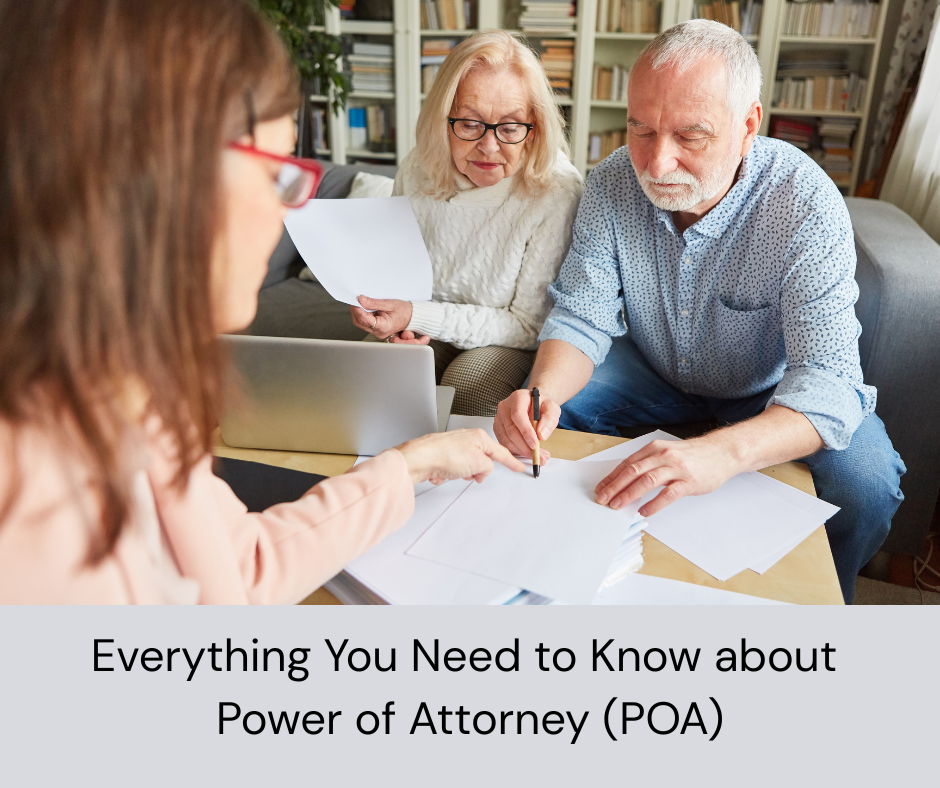
What happens if we don’t have a POA?
If your parent doesn’t have a POA and becomes unable to manage their affairs, no one—not even family—can legally help without going through the courts to be appointed as a guardian or conservator. This process is lengthy, time consuming and expensive. It also usually happens during an already stressful time!
A POA avoids all of that by making sure someone your parent trusts is ready to step in right away.
Two types of POA’s: Standard, Durable
All POA’s let someone (called an agent or attorney-in-fact) act on behalf of another person (called the principal). There are different kinds, but the main distinction comes down to whether or not the authority continues if the principal becomes incapacitated. There are POA’s that solely cover medical or financial decisions but for our purposes we’ll discuss the 2 main types, non-durable and durable.
- Regular Power of Attorney (Non-Durable)
The most important thing to know if that this type of POA is not sufficient for long-term aging or medical planning because it automatically ends if the person becomes mentally or physically incapacitated. It’s the opposite of what you’d need to care for an aging parent. Non-durable POA’s are only used for short-term or specific tasks, like managing someone’s finances while they’re out of the country.
- Durable Power of Attorney (DPOA)
This is ideal for caring for an aging parent because it:
- Stays in effect even if the person becomes incapacitated.
- Allows you to plan ahead for serious illness or cognitive decline.
- Can be created to cover both financial and healthcare decisions.
There’s a third type of POA called a springing POA which “springs into effect” when the principal becomes incapacitated due to illness, injury or cognitive decline. This can be helpful for aging adults who want to preserve independence and don’t need help now (or don’t fully trust their agent). The drawbacks are that proof must be submitted to each of the principal’s doctors, financial institutions, government agencies etc. before you can act on their behalf.
If you’re not sure which POA you have, a Durable Power of Attorney will include language like: This power of attorney shall not be affected by subsequent disability or incapacity of the principal… You can also check with an elder care lawyer.
Where do I get Durable POA? Do I have to have a lawyer?
Your state most likely has a DPOA template you can print out, or you can do an online search for one to download. If the DPOA requires that you sign in front of a notary, you can usually find a notary public at your bank or a mailing and shipping store.
Be sure to use the POA that is specific to your state. Some states require 2 forms; one for financial matters and one for healthcare decisions so be sure to check if 2 forms are needed. Florida for example requires a POA for financial/legal items and then a Designation of Health Care Surrogate for medical and healthcare needs.
Do we need witnesses when we Sign?
Depending on the state in which your parent (the “principal”) resides, yes you both sign the POA, but signing must either be: witnessed by one or two people who aren’t already named as agents or beneficiaries, or witnessed and notarized by a licensed notary public. This helps prevent fraud and ensures the person signing understands the document and is not being exploited.
What do I do with the POA once it is Signed?
- Provide signed copies of the POA to all the organizations with which you might communicate on your parent’s behalf. Banks, financial institutions, doctors, Social Security, Veteran’s Affairs, and insurance providers are common examples.
- Check with each institution to see if you need to provide originals, copies or digital versions.
- Remember to store and keep a copy for yourself.

What If They Don’t Want to Sign?
You can’t force someone to sign a POA. It’s a voluntary legal decision so it’s best to have open, honest conversations to explain why it’s important, especially for their protection and convenience. However, if the person is competent and doesn’t want to sign, you might try suggesting a limited or springing POA. A springing Power of Attorney (POA) “springs” into effect after a specific event occurs—usually the incapacitation of the person. Another option is to involve a trusted doctor, social worker, or religious advisor who can help facilitate trust and clarity.
If the person still won’t sign and they become incapacitated without a POA, and you need to make decisions for them, you will have no choice but to go to court to be appointed guardian or conservator.
What if they’re not competent to Sign?
If the person lacks the capacity to understand the POA at the time of signing, the document is not legally valid.
It’s important to note that a diagnosis of cognitive decline does not necessarily mean the principal can’t sign. The most important thing is that they understand the document at the time they sign. You can have a doctor evaluate mental capacity close to the signing date if there’s any doubt of mental capacity.
In general, the principal is considered competent to sign if they can clearly communicate these things:
1. They know they are giving someone else the authority to act on their behalf.
2. They can explain what the agent will be allowed to do (e.g., manage finances, make health decisions).
3. They can name and recognize the person they are appointing and why they trust them.
4. They know whether it starts now or only if they become incapacitated.
5. Make the choice voluntarily
If they are not competent to sign, you’ll need to apply for legal guardianship through the court system.
What does it mean if I have to become a Guardian or Conservator?
Without a POA, no one—not even close family—can access bank accounts, talk to doctors, or manage utilities without being appointed by the court.
- A guardian is appointed to make decisions about the principal’s health, living situation, and daily care.
- A conservator is responsible for financial and legal matters.
The same person can serve in both roles. The process to become this person requires you to appear before a judge and can take weeks or even months to complete because you’re at the mercy of the medical evaluator and attorney schedules as well as the court’s calendar.
The guardianship and conservator process also includes these expenses
- Court filing fees: These vary by state but can range from a few hundred to over a thousand dollars.
- Attorney fees: You’ll almost always need a lawyer to guide you through the guardianship process, and legal fees can add up to several thousand dollars.
- Court-appointed evaluations: A medical or psychological evaluations is usually needed to assess or sign off on the person’s capacity.
- Bonding Insurance also called a Surety Bond: to cover losses if the guardian mismanages funds or commits fraud.
Once the guardianship is granted, you will need to continually provide an inventory of all of your parent’s assets as well as a detailed accounting of how you manage their expenses. In other words, you will need to keep receipts of every expenditure made on their behalf.
If I can make financial decisions, does that mean I’m responsible for their debts?
No. As a POA, you’re managing your loved one’s finances with their money—not your own. You are not personally liable for their debts as long as you act within your legal duties and in their best interest.
A POA might sound like it is about giving up control, but really about having a safety net. It allows your parent to name someone they trust, with clear limits, so their health and finances are handled according to their wishes. The key is setting it up before there’s a problem.
Leave a Reply