Your cart is currently empty!
Author: eldrapp
How do I replace my Medicare card?
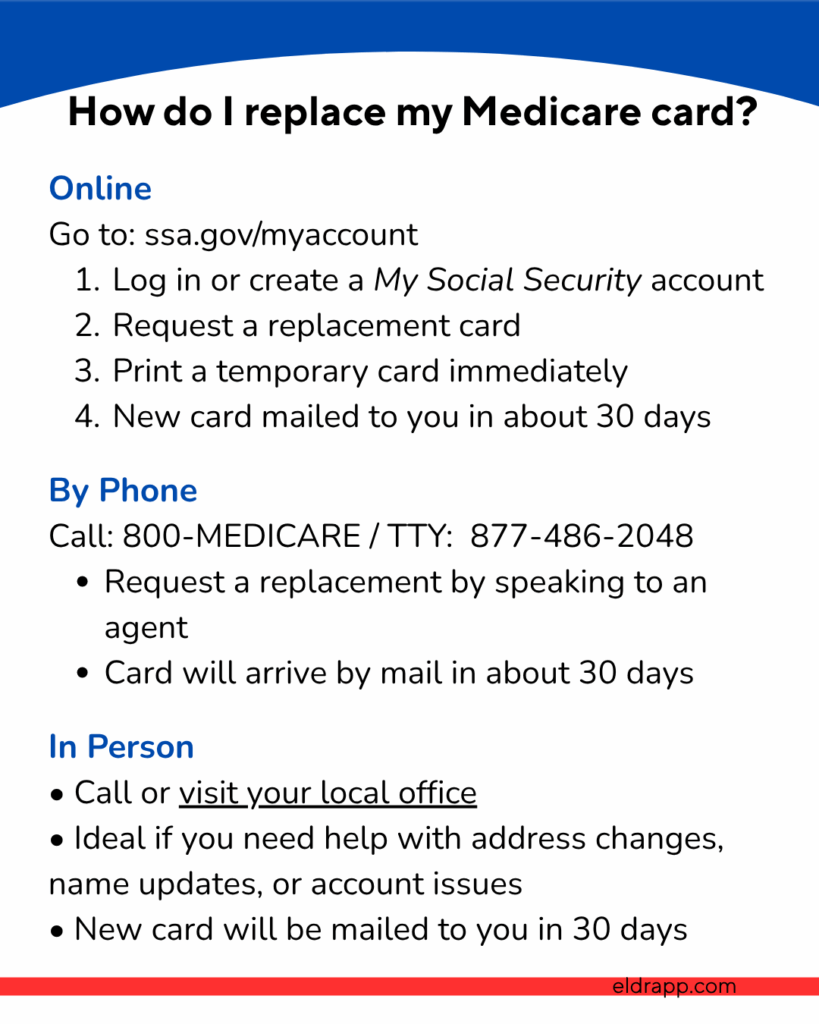
A common Medicare question is “How do I replace my Medicare card?” It happens all the time so don’t worry! You have a few choices of how to get your new card, you can go online, call the Medicare toll free number or visit your local Social Security office in person.
How do I replace my Medicare card? 3 ways:
Online: This is the fastest option and allows you to print a temporary cardVisit: ssa.gov/myaccount
- Log in or create a My Social Security account if your don’t already have one.
- On your account dashboard, look for a section labeled “Replacement Documents”
- Click “Request a Replacement Medicare Card” and enter your info
- Print a temporary card immediately
- The new card is mailed to you in about 30 days
By Phone: An easy option.
Call: 800-MEDICARE (800- 633-4227) / TTY: 877-486-2048
Request a replacement by speaking to an agent.
Your new card will arrive by mail in about 30 days
In Person: Best option if you prefer not to put your information online or if you need to update your name or address.
1. Call or visit your local Social Security office. Find your closest office.
2. Be sure to bring a form of ID like your driver’s license or passport. You don’t need your Social Security card but do need to know the number.
3. If your name or address has changed, be sure to bring legal proof of the change.
4. Your new card will be mailed to you in 30 days
State Health Insurance Assistance Program (SHIP)
Each state, the District of Columbia, Guam, Puerto Rico and the US Virgin Islands have a local State Health Insurance Assistance Program (SHIP). The program is made up of highly trained volunteers who help residents navigate health insurance Medicare for no charge.
In addition to counseling on specific plans, SHIP volunteers also answer questions about eligibility, what’s covered under each part of Medicare and how Medicare compares to your current coverage.Mission: SHIP is your local State Health Insurance Assistance Program. SHIP provides unbiased help to Medicare beneficiaries, their families, and caregivers. Whether you are new to Medicare, reviewing Medicare plan options, or have questions on how to use your Medicare, SHIP can help.
SHIP is locally based and you can find your state’s office below.Caregiver Compensation: Can you get paid as a caregiver for a family member?
You may have wondered if you can receive payments from the government to provide care for a family member who isn’t able to safely live alone. Many caregiver compensation options are managed at the state level, but you’ll want to check both federal programs and state-specific resources to see if there are options.
Here are the specific resources to research your caregiver compensation options:
- National Family Caregiver Support Program (NFCSP)– The NFCSP provides grants to states and territories, based on their share of the population age 70 and over, to fund a range of supports that assist family and informal caregivers to care for their loved ones at home for as long as possible.
- Your State’s Medicaid Office – If someone with a disability already receives Medicaid, their state may allow a family member or friend to become a paid caregiver.
- Your State’s Department of Labor – Some states require employers to offer family leave programs and some programs pay you to care for a family member.
- Veteran’s Caregiver Support Programs – Various options are available for veteran’s on fixed incomes, receiving a pension and those in need of respite care.
- Local Area Agency on Aging (AAA) – If your state does not offer a paid family leave program, an Area Agency on Aging (AAA) may be able to help with: day care programs, meal delivery or other assistance.
- Long Term Care Insurance – If your parent applied for long term care (LTC) there may be provisions for caregiver compensation.
There’s no way around it, getting consistent payment as a caregiver is usually difficult and unlikely to replace the income a person would make outside of caregiving. However, in addition to state and federal resources there are often local community centers, religious organizations and smaller no-profits that can help take some of the financial load off of caregiving.
What is IRMAA?
If you’re surprised to see a higher premium for your Medicare Part B or Part D coverage, it might be because of something called IRMAA, the Income-Related Monthly Adjustment Amount. Here’s what it means, who it affects, and what you can do about it.
What Is IRMAA?
IRMAA is an extra amount added to your monthly Medicare premiums if your income is above a certain level. It applies to both Part B (medical coverage) and Part D (prescription coverage) and is based on your modified adjusted gross income (MAGI) from two years ago.
IRMAA is calculated each year in the Fall, so that Medicare beneficiaries will know what premiums to expect before the Open Enrollment Period, October 15 – December 7.
How Does It Work?
The Social Security Administration reviews your tax return from two years prior. So for 2025, your IRMAA is based on your 2023 tax return. IRMAA is reevaluated each year, so if your income goes up or down, your IRMAA amount, and therefore your total monthly Medicare premiums, can increase, decrease, or even be removed entirely the following year. IRMAA is calculated each year as long as you’re enrolled in Medicare Parts B and/or D, but the amount you pay can stop or drop if your income falls below the IRMAA minimum threshold.
IRMAA can be triggered after significant financial events like selling a house, cashing out retirement savings, or receiving a legal settlement. Even if your income has dropped since the event, if those one time funds put you over the threshold, you will pay IRMAA based on your old income.
It’s important to note that you can also appeal the IRMAA amount. If you’ve had a life-changing event that reduced your income such as retirement, divorce, death of a spouse, or job loss you can request a reconsideration from the Social Security Administration using Form SSA-44. If approved, your IRMAA could be lowered or removed. If you think you’re being charged incorrectly or have had a major life event that impacts IRMAA after the yearly evaluation, don’t hesitate to file an appeal.
Other Things to Know
- IRMAA is not a penalty. It’s an income-based adjustment.
- You’ll get a letter from Social Security explaining your IRMAA and how it was calculated.
- If you delay enrolling in Part B or Part D and are subject to IRMAA, those extra premiums still apply when you enroll.
For more information, premiums and deductibles, please visit Medicare.gov.
Employer Health Plans vs. Medicare: Should You Switch?
As more Americans work beyond age 65, many find themselves wondering whether they should stick with the health insurance they receive from their employer, or switch to Medicare. On the surface, staying with your current health plan might seem like the easiest option; you know your doctors take it and know what costs to expect. But depending on your situation, staying with your “work plan” could end up costing you more.
Here’s what you need to know to make an informed decision.
The Basics: What Happens at Age 65?
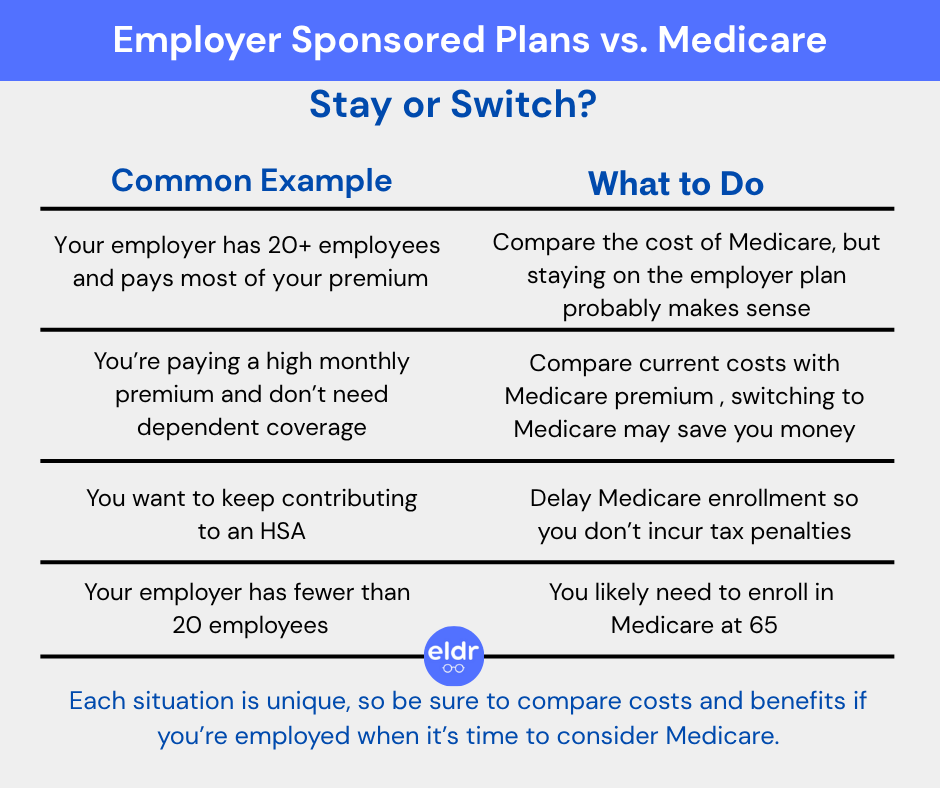
At age 65 you’re eligible for Medicare, the federal health insurance program that covers hospital care, medical services, and prescriptions. But if you’re still working and receive employee healthcare benefits, Medicare eligibility doesn’t mean you have to leave your employer plan. However, doing so might save you money or allow you to receive better benefits. Whether you should keep or leave the employer sponsored plan depends on your job situation, the size of your employer, and your financial and medical needs.
Let’s take each of these point by point:
Your Job Situation: Are You Still Working Full-Time?If you’re still working and actively covered under your employer’s group health plan, you might not need to make any changes right away. In fact, many people continue on their employer plan without enrolling in all parts of Medicare if they like their coverage or are contributing to a Health Savings Account (HSA).
On the other hand, if you’re working part-time or your employer is offering limited coverage, then switching to Medicare might provide less expensive or more complete benefits. This is especially true if you’re paying a large portion of the premium yourself. If you’ve officially retired but your employer is still offering COBRA or retiree coverage, keep in mind that those options do not count as “active employer coverage” for Medicare purposes. This means that if you don’t have active employer coverage, delaying Medicare enrollment could result in penalties.
The Size of Your Employer: Why 20 Is The Magic Number
This is one of the most important factors in your decision. If your company has 20 or more employees, your employer coverage is considered primary insurance, and Medicare is the secondary insurance. That means you can delay enrolling in Medicare Part B (and Part D) without penalty. You’ll qualify for a Special Enrollment Period (SEP) when you retire or lose your group coverage, allowing you to sign up for Medicare at that time without late fees or coverage gaps.
But if your company has fewer than 20 employees, the rules flip and Medicare becomes your primary insurance, and the employer’s plan pays second, if at all. If you delay Medicare enrollment in this case, you might not be covered for services Medicare would normally pay for, and you could end up footing the bill yourself. In short: if your employer is small, don’t wait to sign up for Medicare at 65.
Your Financial and Medical Needs: Compare Costs and Coverage
Even if you’re happy with your employer plan, it’s worth comparing the total costs of staying on that plan versus switching to Medicare. Start by looking at your monthly premiums, co-pays, deductibles, and drug costs. Many people are surprised to find that Medicare is actually more affordable, especially when you add a Medigap or Medicare Advantage plan to help with out-of-pocket expenses.
For example: in 2024, most people paid $174.70/month for Medicare Part B. Some Medicare Advantage plans have $0 premiums and include extra benefits like dental, vision, hearing aids, and even fitness programs. If you’re paying $400 or $500 a month for your job-based plan, Medicare could offer similar or better coverage at a lower cost.
Also consider your medical needs. If you have a chronic condition, need frequent care, or require prescription drugs, check whether your employer plan or a Medicare plan offers better access to the services you rely on. Medicare Part D or Advantage plans may offer stronger drug coverage, while some employer plans limit access to specialists or out-of-network providers.
On that note, while almost all doctors take Medicare, not all doctors will take your specific plan. A doctor might accept Medicare, meaning they take Original Medicare from the federal government, but that doesn’t automatically mean they accept every Medicare Advantage plan (like those from United, Humana or Blue Cross for example). Yes it’s confusing, so if you’re considering Medicare and don’t want to switch doctors, be sure to sign up for a plan that your doctor takes.
A Word About HSA’s
Once you enroll in any part of Medicare you’re no longer allowed to contribute to a Health Savings Account (HSA), because the IRS only permits HSA contributions if you have a high-deductible health plan with no other coverage. Since Medicare counts as additional health coverage, continuing to contribute would violate IRS rules and could result in tax penalties. Many people delay Medicare enrollment specifically to keep contributing to their HSA while still working.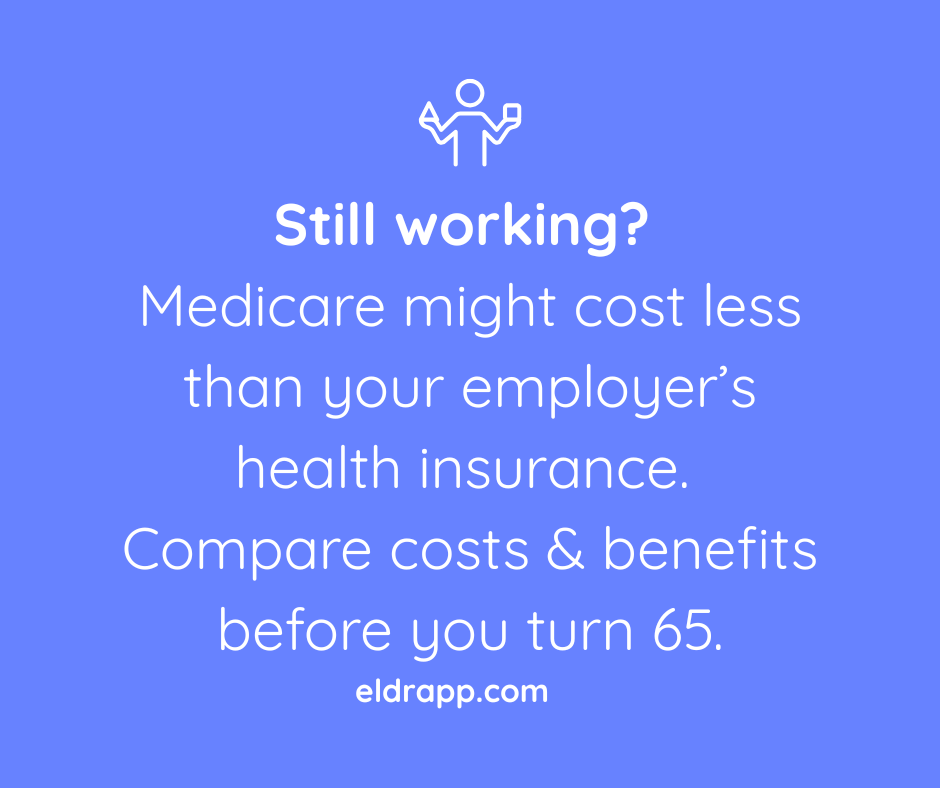
As you approach 65, compare your health insurance options. Speak to your HR department, review your health plan’s costs and coverage, and consider talking with a Medicare advisor. A little homework now can save you thousands later and ensure you’re getting the coverage that’s right for your needs.
Glossary of Elder Care Terms
Quick answers to your health insurance and elder care questions grouped by category.
Health Insurance TermsAffordable Care Act (ACA) – The 2010 law that expanded access to health insurance, protects people with preexisting conditions, and requires most plans to cover essential health benefits.
Accident-only plan – a limited health plan that only covers care needed due to accidents. It won’t cover illness or preventive care.
Allowed amount (or eligible expense) – The maximum amount your insurer will pay for a covered service. If a provider charges more, you may owe the difference if they’re out-of-network.
Balance billing – When a provider bills you for the difference between their charge and what your insurance pays. This usually happens with out-of-network care.
Benefit period – The length of time your insurance plan covers you for services, usually one calendar year.
Catastrophic plan – a low-premium, high-deductible plan designed to protect against very high costs. Available to people under 30 or those with a hardship exemption.
Claim – A request for payment that you or your provider submit to your insurer after receiving care.
Co-insurance – Your share of the costs of a covered service, calculated as a percentage. For example, you might pay 20% of the cost of a service, and your plan pays 80%.
Coordination of benefits (COB) – If you have more than one insurance policy (like through two jobs or a spouse), this determines which pays first and how the other contributes.
Co-pay (copayment) – A fixed amount you pay for a covered service, typically at the time you receive it (e.g., $25 for a doctor visit).
Cost-sharing – Your share of costs for services—includes co-pays, deductibles, and co-insurance.
Coverage area – The geographic region where your plan covers care. This can affect which providers you’re allowed to see and whether emergencies are covered when traveling.
Deductible – The amount you pay for covered health care services before your insurance starts to pay.
EPO (Exclusive Provider Organization) – A type of plan that usually doesn’t cover any out-of-network care except emergencies. Lower premiums, but fewer provider choices.
Essential health benefits – Ten categories of care (like maternity, mental health, and prescription drugs) that most insurance plans must cover under the Affordable Care Act.
Explanation of Benefits (EOB) – A statement from your insurer after a claim is processed, showing what was billed, what was covered, what they paid, and what you may owe. It’s not a bill.
Formulary – A list of prescription drugs your plan covers, often grouped into cost tiers.
Grace Period – A short period after your premium due date during which you can still pay without losing coverage (typically 30 days).
Health Reimbursement Arrangement (HRA) – An employer-funded account that reimburses you for medical expenses. Funds don’t usually roll over if you leave your job.
Health Savings Account (HSA) – A tax-advantaged account you can use to pay for qualified medical expenses. Only available with high-deductible health plans.
High-deductible health plan (HDHP) – A plan with a higher deductible and lower premium, often paired with – an HSA.
HMO (Health Maintenance Organization) – A plan that typically requires you to see doctors within its network and get a referral from your primary care provider to see specialists.
In-network vs. out-of-network – In-network providers contract with your insurance plan and usually cost less. Out-of-network providers haven’t agreed to your plan’s rates and may cost more or not be covered.
Lifetime maximum – A cap on the total amount a plan will pay over your lifetime. These limits are no longer allowed for essential health benefits under the ACA.
Marketplace – The Marketplace (also called the Health Insurance Marketplace or Exchange) is the government-run website or platform where individuals, families, and small businesses can shop for, compare, and enroll in health insurance plans. Plans are also sold from insurers.
Network – The group of doctors, hospitals, labs, and other providers that contract with your insurance company to offer discounted services.
“Obamacare” – The Affordable Care Act (ACA), a 2010 law that expanded access to health insurance, protects people with preexisting conditions, and requires most plans to cover essential health benefits.
Open enrollment – The once-a-year window when you can enroll in, renew, or change – your health insurance plan.
Outpatient care – Medical care or procedures that don’t require an overnight hospital stay (like labs, x-rays, or minor surgeries).
Out-of-pocket maximum (OOP max) – The most you’ll pay in a year for covered care. After hitting this cap, your insurer pays 100% of covered costs.
POS (Point of Service) – A plan that blends features of HMOs and PPOs. You choose a primary care doctor and need referrals, but you can go out-of-network for a higher cost.
PPO (Preferred Provider Organization) – A flexible plan that lets you see any provider, but offers lower costs for using those in the plan’s network. No referrals needed.
Preauthorization (or precertification)– Same as prior authorization—it’s a required OK from your insurer before you get certain treatments or meds.
Premium – The amount you pay—usually monthly—to keep your health insurance policy active.
Preventive care – Routine health services like screenings, check-ups, and vaccinations meant to catch problems early. Most plans cover these at no cost to you.
Primary care provider (PCP) – Your main doctor who manages your overall health and refers you to specialists as needed.
Prior authorization – Advance approval from your insurance company for certain procedures, treatments, or medications. Without it, your insurer may not pay.
Referral – An order from your primary care provider for you to see a specialist or get specific services. Often required by HMO plans.
Special enrollment period – A time outside of the standard open enrollment when you can sign up for or change your health insurance triggered by events like having a baby or losing coverage
Subsidy – Financial help (usually based on income) from the government to lower your monthly premium or out-of-pocket costs when buying insurance through the Marketplace.
Legal Terms in Healthcare
Durable Power of Attorney (DPOA)-A type of POA that remains valid even if the person becomes incapacitated due to illness, injury, or mental decline. It is commonly used in long-term care planning and can be for both financial and healthcare matters.
Power of Attorney (POA) A general term for the legal document that allows one person (the principal) to give another person (the agent or attorney-in-fact) the authority to act on their behalf.
Medical Power of Attorney (Healthcare POA) – A specific type of POA that gives someone authority to make healthcare decisions when the individual is no longer able to do so. Also called a Health Care Proxy.
Advance Directive (AD) – A legal document that outlines a person’s medical treatment preferences in case they become unable to communicate. Also known as: Living Will, Healthcare Directive,Medical Directive. It is used along with a POA.
It might include:
- Whether they want life support (ventilator, feeding tube)
- Pain management preferences
- Do Not Resuscitate (DNR) orders
- Organ donation choices
Living Will – A type of advance directive that states preferences for life-sustaining treatments (e.g., ventilators, feeding tubes, resuscitation) if you are facing a terminal illness, irreversible unconsciousness or other end-of-life condition. It applies only while you are alive but lack the capacity to communicate your wishes.
Do Not Resuscitate (DNR) Order – A medical order that tells healthcare providers not to perform CPR (cardiopulmonary resuscitation) if your heart stops or you stop breathing. A DNR only applies to resuscitation.
POLST / MOLST
- POLST = Physician Orders for Life-Sustaining Treatment
- MOLST = Medical Orders for Life-Sustaining Treatment
These are doctor-signed orders based on your wishes for emergency care. They are ,ore specific than an advance directive and often used by people with serious illness.
Legal Terms in Financial Matters
Trustee – A trustee manages a trust, which is a legal arrangement where one person (the trustee) holds property or assets for the benefit of another (the beneficiary)
Conservator – appointed by a court to manage the financial affairs of an adult who is no longer able to do so themselves due to incapacity. This is also called Guardian of the Estate in some states.Executor An executor is a type of fiduciary. the person named in a will to handle someone’s estate after they die.
Fiduciary -is a broad legal term for person or institution legally obligated to act in someone else’s best interest, especially in managing money or assets. Trustees, executors and conservators are all fiduciaries.
Guardian – appointed by a court to make personal, medical, and sometimes residential decisions for someone who is legally incapacitated. This is different from a conservator, who handles money.
Intestate – Dying without a valid will. If this happens, the state decides how assets are distributed.
Financial POA: A specific type of POA that gives someone authority tohandle money, bills, property, and financial affairs when the individual is no longer able to do so.
Durable Power of Attorney (DPOA)-A type of POA that remains valid even if the person becomes incapacitated due to illness, injury, or mental decline. It is commonly used in long-term care planning and can be for both financial and healthcare matters.
Probate -the court-supervised process that settles a person’s estate after they pass away.
Types of Trusts
A trust is a legal arrangement where one person (the trustee) manages money or property for someone else’s benefit (called the beneficiary) according to rules set by the person who created the trust (the grantor).
Revocable Living Trust Revocable Living Trust
- What it is: Created by an individual (the “grantor”) during their lifetime.
- Why it’s used: To avoid probate, keep control of assets, and provide seamless management if the person becomes incapacitated.
- Flexibility: Can be changed or revoked at any time.
- Best for: General estate planning, providing a smooth transition of control.
Irrevocable Trust
- What it is: Once created, it generally cannot be modified or revoked.
- Why it’s used: Protect assets from creditors, reduce estate taxes, and sometimes qualify for Medicaid.
- Best for: Long‑term care planning and asset protection.
Medicaid Asset Protection Trust (MAPT)
What it is: A special type of irrevocable trust.
Why it’s used: Protect assets from being counted as “available” for Medicaid eligibility after a certain look‑back period.
Best for: Helping older adults qualify for long‑term care benefits while preserving a legacy for heirs.
Special Needs Trust (SNT)
- What it is: Created for an individual with a disability.
- Why it’s used: Provides supplemental support for someone with special needs without disqualifying them from government benefits.
- Best for: Elderly or adult children with disabilities, or aging adults who might require long‑term care.
Testamentary Trust
- What it is: Created upon death through a Will.
- Why it’s used: Provides structure for distributing and managing an inheritance, especially when the beneficiary may be too old, too young, or unable to manage it themselves.
- Best for: Helping older adults plan for a spouse or dependent’s long‑term care.
Qualified Income Trust (QIT) or Miller Trust
- What it is: Created to help someone qualify for Medicaid when their income is too high.
- Why it’s used: Enables the person to access long‑term care benefits despite exceeding income limits.
- Best for: Older adults in nursing homes or requiring long‑term care services.
Veterans Asset Protection Trust – An irrevocable trust designed for veteran benefits. Helps protect a veteran’s assets from being counted when applying for VA pension benefits like Aid and Attendance.
Medicare
Medicare health insurance for people 65 or older. You may be eligible to get Medicare earlier if you have a disability, End-Stage Renal Disease (ESRD), or ALS (also called Lou Gehrig’s disease). Medicare is a BIG topic so we suggest starting here at Medicare.gov.
Medicare Part A is hospital insurance that covers inpatient care in hospitals, skilled nursing facility care, hospice care, and some home health care services. Most people don’t pay a premium for Part A if they or their spouse paid Medicare taxes while working.
Medicare Part B is medical insurance that helps cover services like doctor visits, outpatient care, preventive services, and some home health care. Part B typically requires a monthly premium and may also include a deductible and coinsurance.
Medicare Part C also known as Medicare Advantage Plans and are an alternative to Original Medicare. These plans are offered by private companies approved by Medicare and often include Part A and Part B coverage, along with additional benefits like vision, dental, hearing, and sometimes Part D drug coverage.
Medicare Part D is prescription drug coverage provided by private insurance companies approved by Medicare. It helps pay for the cost of prescription medications and may include monthly premiums, deductibles, and copayments or coinsurance.
Medicare Advantage Plans, also known as Part C, are an alternative to Original Medicare. These plans are offered by private companies approved by Medicare and often include Part A and Part B coverage, along with additional benefits like vision, dental, hearing, and sometimes Part D drug coverage.
Medicare Supplement Plans, also called Medigap, are private insurance policies that help pay some of the out-of-pocket costs not covered by Original Medicare, such as copayments, coinsurance, and deductibles. These plans do not work with Medicare Advantage Plans and do not include prescription drug coverage.
Medigap Plans are also called Medicare Supplement Plans are private insurance policies that help pay some of the out-of-pocket costs not covered by Original Medicare, such as copayments, coinsurance, and deductibles. These plans do not work with Medicare Advantage Plans and do not include prescription drug coverage.
Donut hole (Medicare Part D) – A temporary coverage gap in Medicare prescription drug plans where you may pay more out-of-pocket for medications until reaching a spending threshold.
Income-Related Monthly Adjustment Amount (IRMAA) – Medicare uses your tax return from two years ago to determine how much you’ll pay for Part B (medical coverage) and Part D (prescription coverage). If your income was above certain thresholds, an extra charge will be added to your premium. In other words, the more you earned two years ago, the more you may pay for Parts B and D today.
Medicaid
Medicaid Spend Down– When someone has too much income or too many assets to receive Medicaid, they will use that income on medical or care-related expenses in order to “spend down” until they reach Medicaid eligibility.
Look-Back Period – Medicaid checks financial transactions made during the 5 years (60 months) prior to the application date. Gifts, transfers, or selling property below market value during this time may trigger penalties.Penalty Period – If you violated the look-back rules, this is how long Medicaid will withhold long-term care coverage. It’s calculated by dividing the amount improperly transferred by the average monthly cost of nursing home care in your state.
Asset Limit / Resource Limit – The total countable assets you can have and still qualify. Typically $2,000 for a single person in most states, but this varies.
Countable vs. Non-Countable Assets -Not all assets “count” toward the asset limit.
- Countable: cash, stocks, vacation homes.
- Non-countable: primary home (if equity is under limit), one car, personal belongings, irrevocable funeral trusts.
Community Spouse – The healthy spouse of someone entering long-term care. They’re allowed to retain certain income and assets to prevent impoverishment, protected under spousal impoverishment rules.
Healthcare
Activities of Daily Living (ADLs) – Basic self-care tasks: bathing, dressing, eating, toileting, and mobility.
Instrumental Activities of Daily Living (IADLs) – More complex daily tasks like managing finances, transportation, medication management, cooking, and housekeeping.
Palliative Care – Medical care focused on relief from symptoms and stress of serious illness. This can be given along with curative treatments and does not have to happen at the end of life. The goal is to make life as comfortable as possible for someone with a chronic condition.
Hospice – Care for people in the final stages of terminal illness—focused entirely on comfort and not curative treatment.
Respite Care – Temporary care provided to give a break to the regular caregiver.
Long-Term Care – Umbrella term for services and support for personal care needs over an extended period; nursing homes, home health aides, and assisted living.
State Health Insurance Assistance Programs (SHIP) – Free, local, in-depth, and objective insurance counseling and assistance to Medicare-eligible individuals, their families, and caregivers.
Do you Need a Hearing Aid?
Hearing loss often happens gradually, making it easy to miss the early signs. A self-assessment can help older adults recognize changes in hearing that may affect communication, safety, and overall quality of life. By answering a few simple questions, you can better understand when it might be time to speak with an audiologist or consider hearing aids.
Keep this card with your health records or bring it to your next checkup, it’s a small step that can make a big difference in staying connected and independent.
In Case of Emergency (ICE) Card
In an emergency, seconds matter and clear, accessible medical information can save a life. For older adults, an In Case of Emergency (ICE) card or paper ensures that first responders and healthcare providers have immediate access to vital details such as medications, allergies, and emergency contacts.
Seniors are encouraged to keep their ICE card in a highly visible and easy-to-reach place, such as their wallet, purse, glove compartment, or posted on the refrigerator. This information provides peace of mind and helps ensure the right care is delivered safely and without delay.

Understanding the Types of Senior Living: A Practical Guide for Families
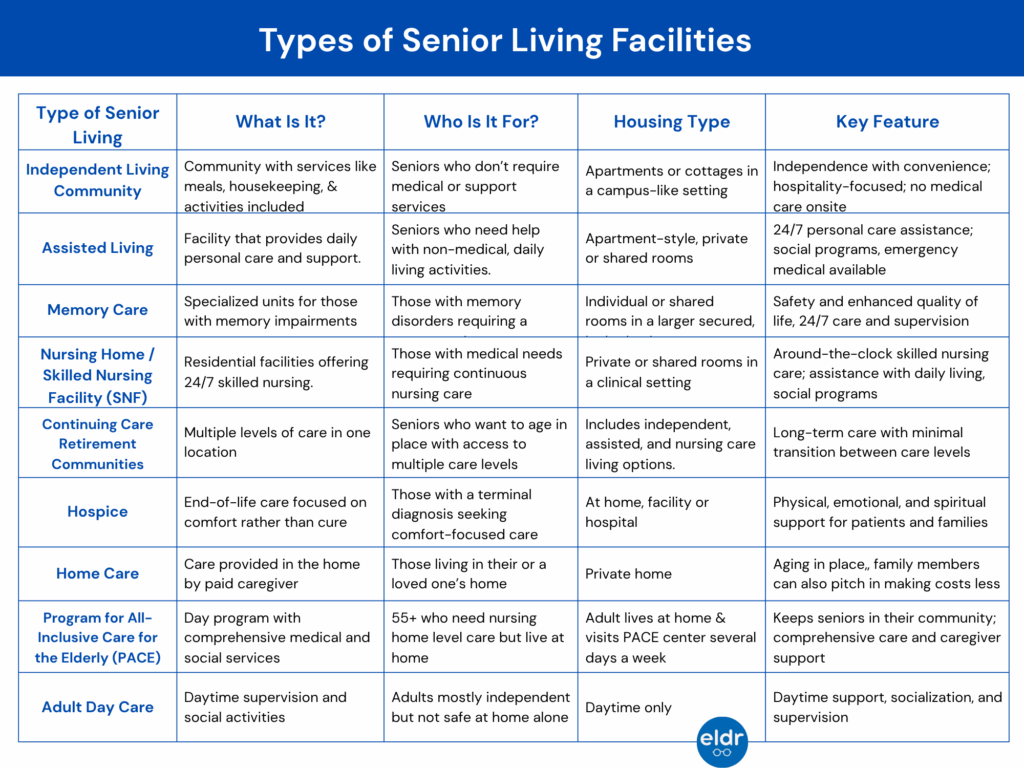
When supporting aging parents or loved ones, choosing the right senior living arrangement can be challenging. If you’re exploring senior living for the first time, it’s normal to be confused by the different housing categories; many terms sound alike and franchised facilities might use names tailored specifically to their brand. This guide, Understanding the Types of Senior Living: A Practical Guide for Families, breaks down what each option offers, typical costs, and key considerations to help families make informed decision.
55+ Community Age-Restricted Housing
These are also called active adult communities, retirement communities or age-qualified housing. They’re simply neighborhoods that are just for adults age 55 and up.
Who are they for? Retired or semi-retired adults where at least one resident in the home is age 55 or older. They may or may not allow children in the community, as the Housing for Older Persons act allows 55+ communities to legally exclude younger residents under certain conditions.
- Housing Type: Typically single-family homes, condos, or apartments.
- Services: May or may not include amenities like a clubhouse, pool, lawn care, or organized social events.
- Support or Medical Services: None or very limited. Residents are fully responsible for their own care, meals, transportation, etc.
- Focus: Lifestyle and age-based community living. Think retirement lifestyle, not care.
- Typical Cost: Matches typical mortgage or rent rates in the area.

Understanding the Types of Senior Living: A Practical Guide for Families Independent Living Community
You might also hear these called retirement communities (like the 55 and up communities) or “senior living.”
Who are they for? Independent living is for adults usually age 55 or older who don’t require medical or support services on-site. Independent Living is different than a 55+ community as it usually includes meals, housekeeping, transportation, maintenance, and a calendar of activities. It’s more about ease of lifestyle, not medical need.
- Housing Type: Apartments or cottages within a campus-like setting. While not required, many facilities will have medical alert systems in their residences either mounted on the walls, voice activated or given to residents to wear.
- Services: Usually includes meals, housekeeping, transportation, maintenance, and a full calendar of activities.
- Support or Medical Services: No medical or daily care, but emergency help may be on-site or easily accessible through a medical alert system.
- Focus: Independence with convenience, it’s more of a hospitality model rather than healthcare.
- Cost: Varies depending on geographical location but the national average is $2000 – $4000 per month.
Assisted Living
Assisted living facilities provide daily care with activities of daily living (called ADL’s) but not as much help as a nursing home provides. Residents have their own apartments or rooms with shared common areas.
Who are they for? Seniors needing help with daily activities like bathing, dressing, medication reminders, or mobility support.
- Housing Type: Apartment style; either private or shared with a basic kitchenette
- Services: 24/7 staff for personal care assistance like: medication reminders, mobility, dressing and hygiene
- Support Services: Meals, housekeeping, laundry, transportation and social and recreational programs
- Typical Cost: The national average is $4,000 to $6,500 per month with costs increasing as care needs increase. Usually paid out-of-pocket but some aspects may be covered through Medicaid for individuals that qualify. Coverage varies by state.
Memory Care
Memory care is a specialized type of senior living designed to support those with memory conditions such as Alzheimer’s or Dementia. Oftentimes Memory Care is a dedicated unit that is part of an assisted living or nursing home community.
Who is it for? Individuals with memory related conditions such as Alzheimer’s, dementia, or other cognitive impairments needing specialized supervision and care.
- Housing Type: Individual or shared rooms in a secured and safe facility. Besides having staff specifically trained in memory disorders, the key difference between assisted living and memory care is that memory care has locked and secure units to prevent residents from wandering.
- Services and Support: 24/7 supervision and assistance with ADL’s, structured routines and activities tailored to those with memory disorders, medical staff on site, and a secure environment.
- Focus: Safety and enhancing the quality of life for those with memory disorders.
- Typical Cost: $6,000 to $10,000+ per month. The higher cost reflects specialized care and security needs. While it may cover skilled nurse visits related to memory issues; wound care after an accident that occurred as a result of the memory loss for example, Medicare does not cover Memory Care.
What Are Nursing Homes? And What About Skilled Nursing Facilities?
You might hear a Nursing Home also called a Skilled Nursing Facility (SNF). It’s important to know that all Skilled Nursing Facilities are nursing homes, but not all nursing homes are SNFs. The main difference is that a SNF provides short-term care after a hospital stay while nursing homes offer long-term care for individuals who need ongoing assistance.
Nursing homes are residential facilities with 24/7 supervision and care, designed for those with complex medical needs. You might also hear these called long-term care facilities or convalescent homes.
Who are they for? Seniors with complex medical needs requiring 24-hour nursing care and rehabilitation services. These seniors are too medically fragile for assisted living.
- Housing Type: Private or shared rooms within a clinical, residential care setting that provides 24/7 medical and personal care.
- Services and Support: – All medical management and social activities happen in the nursing home under the supervision of trained staff. Licensed nurses are available around the clock.
- Focus: around-the-clock skilled nursing care and assistance with daily living activities for those with significant medical needs or disabilities who cannot be safely cared for at home or in less intensive settings.
- Typical Cost: $8,000 to $11,000+ per month Medicare covers short-term stays; Medicaid may cover long-term stays depending upon the state and eligibility.

Continuing Care Retirement Communities (CCRCs)
You might hear these referred to as “age in place” option or a “full-service retirement community.”
A CCRC is a comprehensive senior living community that offers multiple levels of care in one location, so residents can move between levels as their needs change without having to leave the community.
Who are the for?
Seniors who want to “age in place” with access to multiple levels of care on one campus, who also have the financial means to pay the entrance fees and ongoing monthly fees that rise as more services are needed and added.
- Housing Type: Independent, assisted living, and nursing care available in a campus style setting.
- Services and Support: Community amenities, meals and social activities and then progressing to assistance with ADL’s and/ or medical care if and when needed.
- Focus: Long-term care living in one location with minimal transition needed between care levels.
Typical Cost: Entrance fees can range from $100,000 to $1 million+. Monthly fees then range from $3,000 to $8,000+ as care progresses. The cost is relatively expensive because it includes housing, meals, social programs, healthcare, and skilled nursing all in one package.
Hospice
Hospice is end-of-life care focused on making the person comfortable, rather than curing them. It provides physical, emotional, and spiritual support for individuals who are terminally ill, along with their families.- Who is it for? Hospice is for those with a terminal diagnosis comfort-focused care over curative treatment
- Housing Type: Hospice is a care service, so it can happen in the home, the facility where the senior lives, a hospital where the senior was admitted or dedicated hospice facilities.
- Services: The hospice patient receives pain and symptom management as well as emotional and spiritual support administered by hospice nurses, social workers, religious or spiritual counselors and volunteers. Additionally the patient’s loved ones can receive social support if they wish, as well as bereavement support after death occurs.
- Typical Cost: Usually covered by Medicare or Medicaid or traditional health insurance. Private pay is rare.
Understanding the Types of Senior Living: A Practical Guide for Families- More Senior Living Considerations
Home Care
It’s important to mention that families can certainly keep their older loved ones at home as they age. Care provided at home, ranging from non-medical assistance to skilled nursing. Costs vary widely depending on the type of care and can be from $25 to $80+ per hour. Medicare and Medicaid may step in depending upon financial eligibility and the state where the senior lives.
Program for All Inclusive Care for the Elderly (PACE)
PACE provides comprehensive medical and social services to eligible older adults as an alternative to entering a nursing home. Costs and availability depend on your area. PACE supports home caregivers with a place for seniors to receive medical checkups, rehab therapy, meals, and activities several days a week. Transportation is also included. PACE centers operate during the day, but services can be accessed 24/7.
- Who is it for? Adults age 55+ who live at home but have been certified by the state as meeting the need for the nursing home level of care.
- Housing Type: PACE can be an “adult day care” in that care happens during the day but it offers comprehensive medical care and specialized supervision by a team. Participants don’t live at a PACE center, rather they visit several times per week. Caregivers can also come to your home depending on your area.
- Services: via their website, “PACE covers all Medicare Parts A, B and D benefits, all Medicaid-covered benefits, and any other services or supports that are medically necessary to maintain or improve the health status of PACE program participants.”
- Focus: Allowing seniors to remain in their home and community while providing comprehensive medical and support services. This includes relief and resources for their family caregivers.
- Typical Cost: PACE is funded mainly through Medicare and Medicaid. Availability and costs depend on your location but here’s how cost breaks down in general:
- Dual-eligible (Medicare + Medicaid): No monthly premium, out-of-pocket costs are typically minimal
- Medicare only: May pay a monthly premium, often several thousand dollars per month
- Private pay (neither Medicare nor Medicaid): Pay full cost out-of-pocket.
Adult Day Care
Adult day care is daytime support for any adult, regardless of age, who is mostly independent but not safe to be left home alone. Adult day care centers are a senior center, social services facility or private facility.
Costs vary widely as they may be subsidized by Medicaid, Veteran’s Affairs or state programs like Area Agencies on Aging. Many facilities are also private pay, and Medicare does not pay for adult day care. A good start to find adult day care is to search: your county name + Area Agency on Aging.
Long Term Care
“Long term care” (LTC) is an umbrella term that refers to the various housing and care options for those who need ongoing medical attention or assistance with daily activities. So if you hear someone talking about LTC it may be because they’re speaking about services needed that aren’t specified yet. A doctor may say for example, “Your father-in-law had a stroke so he’ll need long-term care after the stroke.” This can mean a nursing home, assisted living, skilled nursing facility or memory care.
LTC is not age dependent; anyone can be in long term care due to illness, injury or disability but 80-85% of residents are seniors.
When it’s Time to Decide
The type of care you or your loved one needs might need to be decided quickly due to an accident or medical event. For that reason, it’s important to have a Durable Power of Attorney, as well as an Advanced Directive in place. This way your wishes for living space and healthcare are plainly documented in the event that you or your loved one are unable to communicate your wishes. Whatever choice is made, facilities almost always have a dedicated support staff to guide you, and there are also outside resources to support you.Driving and Aging: When to Hand Over the Keys
Giving up driving is one of the hardest decisions many older adults face. Driving represents independence, freedom, and the ability to stay socially connected. But at some point, safety may need to take priority. There’s no exact age when someone should stop driving, and the right decision often depends on a mix of medical, cognitive, and physical factors. This guide walks through how seniors and their families can evaluate driving ability and find ways to stay mobile without a car.
Prepare for the Possibility
Just like setting up a will or power of attorney, it’s a good idea to talk with your family and decide on clear signs for when it might be time to stop driving. Have this discussion before any problems come up. That way, you can all agree on what signs to look for and avoid tough decisions later when emotions might be running high.
In addition to having a clear plan for when it’s time to give up the keys, be sure to also plan for other alternatives so you still have transportation (and independence!). Keep reading for transportation options.

Warning Signs That It Might Be Time to Stop Driving
Signs that driving may no longer be safe include:
- frequent close calls or accidents
- getting lost on familiar routes
- confusion between the gas and brake pedals
- delayed responses to traffic signals
- increased anxiety or frustration while driving
Family and friends may also notice dents on the car, receive complaints from others, or a reluctance to drive at night or in unfamiliar areas. These signs are often gradual, and it’s important to pay attention to changes over time.
What the DMV Can Tell You
The Department of Motor Vehicles (DMV) in many states has specific rules or guidance for older drivers. For example, some states require drivers over a certain age—often between 70 and 80—to renew their license in person, rather than online. They may also require vision tests, written exams, or even road tests. State requirements vary, so it’s worth checking with your local DMV or visiting NHTSA’s Senior Driving site for resources.
How to Get Evaluated
If you’re noticing warning signs in the driver, it’s a good idea to start with a conversation. Ask if they’ve noticed any challenges. Sometimes, seniors already feel less confident and are open to cutting back.
A medical check-up can also help rule out reversible issues such as medication side effects, vision changes that can be helped, or early-stage illness.
You can schedule a formal driving evaluation through AAA. As the AAA site says, “Think about getting a professional driving assessment the same way you look at visiting your doctor for annual wellness checkups – as a smart way to identify and manage any physical or mental changes.”
Before a complete stop on driving is needed, consider setting limits instead of stopping completely: only drive during daylight, avoid highways or bad weather, or stick to familiar routes. This gives the driver some control while reducing risk.

Planning for Life After Driving
Losing the ability to drive doesn’t have to mean losing independence. It just means using new ways of getting around. Having these options in place and even using them before you have to can minimize frustration and make the transition a little easier.
Here are some practical options:
- Uber Assist – is designed for seniors and people with disabilities. Drivers are trained to offer additional assistance, such as helping passengers in and out of the car.
- Uber Phone booking: Rides can be booked over a smartphone by calling in. It is the same Uber service, just done outside of the app.
- Lyft Silver: A simpler version of the Lyft app designed for seniors who do not need help in and out of the vehicle.
- GoGoGrandparent: a third-party service that works with both Uber and Lyft to help seniors and disabled people access rides (and other services) using a landline or basic phone
- Volunteer Driving Programs: Nonprofits and faith-based groups often have volunteers who provide rides to medical appointments, grocery stores, or social activities.
- Community Shuttles: Senior centers, local governments, or housing developments may provide scheduled shuttle services.
- Family and Friends: Create a shared driving calendar or set up a routine with loved ones for rides.

You might also consider delivery services for groceries and medications, or telehealth appointments to reduce the need for transportation.
The decision to stop driving is rarely easy, but it doesn’t have to mean giving up independence. With a thoughtful plan and familiar transportation options in place, the transition can feel manageable—just like any other life change. If you’re helping a loved one navigate this step, offer support through compassion, clear information, and practical solutions.
